
CS-500 Liquid-Nitrogen Cryogenic Suppression System
A fully automated suppression unit that stores, pressurises, detects and discharges liquid nitrogen at −196°C. It interrupts lithium battery thermal runaway at the earliest stage through oxygen displacement, deep cooling and explosion control — stopping deflagration before it starts, not fighting the fire after it has begun.
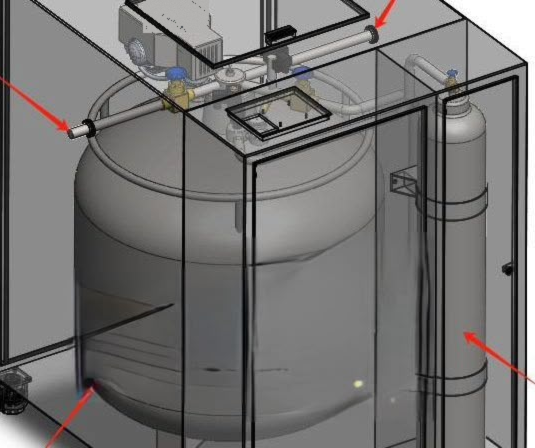
Interrupting thermal runaway before deflagration
Lithium battery thermal runaway is a chain exothermic reaction. The value of liquid nitrogen is not post-event firefighting — it is simultaneously cutting oxygen, cooling deeply and controlling explosion, so the reaction cannot propagate.
Three simultaneous actions
- Oxygen displacement: vaporised nitrogen rapidly replaces oxygen in the enclosure, dropping it to ≤10% so the flame loses its oxidiser
- Deep cooling: the −196°C medium removes heat directly, suppressing the temperature rise rate and breaking the exothermic chain
- Explosion control: flammable gas accumulation is inhibited before deflagration, preventing in-cabinet ignition and re-ignition
How it differs from conventional fire suppression
- Not "adding an extinguisher" — interrupting thermal runaway before deflagration occurs
- Clean medium: no residue, non-conductive, no damage to cells or electrical components
- Fully automated: interlocks with the fire system and BMS, no manual intervention required
- Static evaporation rate of 0%/day — no frequent top-up maintenance
Four units, delivered as one skid
Storage, pressurisation, detection and discharge are integrated on a single skid — position on site, connect and commission.
Mechanism parameters and equipment ratings
Structured for item-by-item comparison against fire-safety design and procurement clauses.
| Parameter | CS-500 | Mechanism / note |
|---|---|---|
| Suppression medium | −196°C liquid nitrogen | Ambient-pressure liquid storage; inert, non-flammable, non-conductive |
| Suppression mechanism | Oxygen displacement + cooling + explosion control | Interrupts the thermal runaway chain at source |
| Expansion ratio | Approx. 696× | A small liquid volume fills the enclosure rapidly |
| Chamber O₂ after suppression | ≤ 10% | Flame extinguishes through oxygen starvation; no re-ignition |
| Response mode | Suppression on thermal runaway · fully automatic | Interlocked with fire system / BMS; no manual intervention |
| Equipment rating | Value | Equipment rating | Value |
|---|---|---|---|
| Liquid nitrogen capacity | 500 L | Device response time | 0.01 s |
| Static evaporation rate | 0%/day | Working pressure | 0 – 0.5 MPa |
| Rated power | 2.0 kW | Power supply | AC 220V / 50Hz |
| Dimensions (W×D×H) | 1440 × 1220 × 1910 mm | Operating temperature | −55°C to +55°C |
Generation side and storage side share one technology base
HiSRSD and CS-500 share LDSW national-standard communication, in-house SOC silicon and TinyML edge intelligence — for the customer that means one supplier, one interface and one safety record.
| Dimension | HiSRSD · Generation side | CS-500 · Storage side |
|---|---|---|
| Protected hazard | DC high-voltage shock and string arcing (up to nearly 1 kV) | Lithium battery thermal runaway, flammable gas and in-cabinet deflagration |
| Primary action | Module-level shutdown within 25s; array voltage down to ≤1V | Oxygen displacement + deep cooling + explosion control at runaway onset |
| Trigger criteria | Power loss / command / fire interlock / edge AI diagnosis | Temperature rise, smoke and characteristic gas, with two-parameter confirmation |
| Delivery format | Shutdown device + gateway + cloud platform; wireless, cable-free | Storage + pressurisation + detection + discharge; one integrated skid |
| Typical application | Distributed rooftops, carports, ground-mount plants, metro depots | Containerised BESS, C&I storage cabinets, distribution-area storage |
| Shared foundation | LDSW national-standard communication (YD/T 6334-2025) + in-house SOC silicon + TinyML edge intelligence + unified O&M entry point | |
From C&I storage cabinets to plant-scale enclosures
Containerised BESS plants
Enclosure-level suppression covering cell clusters and busbar areas; suits new build and retrofit alike.
C&I storage cabinets
In-cabinet rapid suppression and alarm linkage for factory and industrial-park storage.
Distribution-area storage
Low-maintenance, unattended operation for small storage units on distribution networks.
Plant-scale storage clusters
Zoned deployment across multiple enclosures, unified on one platform to form a site-level safety record.
Storage safety is not "fitting an extinguisher" — it is stopping thermal runaway before deflagration
We provide enclosure volume calculation, piping layout guidance and acceptance criteria, and can support design institutes with fire-safety design coordination.